Material Forming Processes
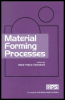
This text covers techniques such as injection molding, composites forming, die extrusion, hydro-forming, blowing, forging, machining and cutting, super plastic forming, as well as a number of other specific processes.
 TABLE OF CONTENTS
 J. Chen and D. S. Lussier
Advanced Composite Materials and Textile Research Laboratory, Dept of Mechanical Engineering, University of Massachusetts Lowell, USA
J. Cao and X. Q. Peng
Advanced Materials Processing Laboratory, Dept of Mechanical Engineering, Northwestern University, Evanston, Illinois, USA
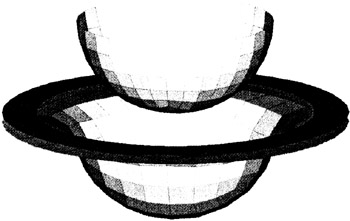
Stamping of continuous fiber, woven fabric offers the promising combination of short cycle times and structural properties. The glass fibers are commingled with thermoplastic (polypropylene or PP) fibers to promote ease of handling and thorough and rapid wetting of the glass fibers. The commingled glass/PP sheets can be heated above their melting temperature, formed to a shape, and cooled back to a rigid solid without drastic changes in their original properties. Figure 1 shows an example of a hemispherical stamping tool.
Numerical simulations of forming processes can be powerful tools for materials selection, tool design, and process optimization. All simulations require the input of material parameters and correct material models. Adding complexity to the problem, the properties of textile reinforcements are constantly changing during forming. Shear frame tests, bias extension tests, and biaxial tests [BOI 97, FRI 98, LUS 00a, LUS 00b, MCG 98, MOH 00, SOU 00, WIL 99] are just some of the methods currently being utilized to quantify these evolving material properties. However, test method variations reported in the literature and proper interpretation of test results add to the uncertainty. Clearly, improvements in the predictive capabilities...