Material Forming Processes
This text covers techniques such as injection molding, composites forming, die extrusion, hydro-forming, blowing, forging, machining and cutting, super plastic forming, as well as a number of other specific processes.
 TABLE OF CONTENTS
 Martin Rohleder and Karl Roll
DaimlerChrysler AG, Production Planning Mercedes-Benz Passenger Cars, Sindelfingen, Germany
Alexander Brosius and Matthias Kleiner
University of Dortmund - Chair of Forming Technology, Germany
For the manufacture of complex body, frame and running gear parts in the automotive industry various techniques of sheet metal forming are used. Typical for these complex sheet metal forming parts is inhomogeneous deformation, which leads, together with elastic-plastic material properties and the form drag caused by the geometry of the part, to deviations from the desired shape after unloading. This phenomenon is called springback.
Because of automated production and demand for high dimensional and shape accuracy nominal geometry deviation due to springback becomes a central concern (Roll et al., 2000); (Wagoner et al., 1996); (Roll, 1997). In the context of lightweight vehicle construction the problem is amplified by the increasing use of high-strength steels and aluminum alloys. These alloys show in general larger deviations due to springback compared with conventional mild steel (Beth, 1993). Despite intensive efforts throughout the last years a reliable prediction of springback deviations by means of finite element simulation is still not possible.
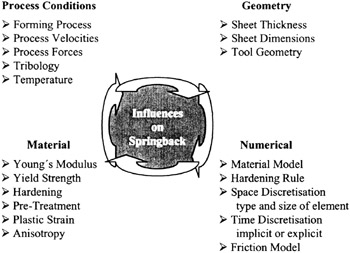
Springback results of sheet metal forming simulations are influenced by a large number of variables (Wagoner et al., 1996). Physical and process specific variables influencing the amount of springback are already determined (Beth, 1993). If springback is calculated numerically in addition to the variables mentioned above, numerical variables have an influence, see Figure 1.