A matrix is a set of numbers or other mathematical elements arranged in a rectangular array of rows and columns. The structure of a matrix makes it easy to assemble and work with certain kinds of mathematical data. The coefficients of a set of simultaneous linear equations or the coordinates of a point can be written as a matrix, for example. However, a matrix is not just a tool to organize data. One matrix can operate on another matrix to change the data in some way. For example, we can use matrices to solve complex systems of equations, to represent geometric objects in computer data bases, and to perform geometric transformations, such as translation, rotation, and scaling. The rules of matrix algebra define allowable operations in these areas. But before we can do any of these things, we must study some simple properties of matrices and some matrix arithmetic and algebra. Along the way, we will review determinants, which look much like matrices but really aren't.
2.1 Definition of a Matrix
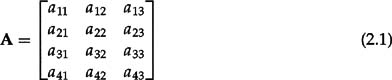
A matrix is a rectangular array of numbers, or their algebraic equivalents, arranged in m rows and n columns. We denote a matrix with a boldface uppercase letter, such as A, B, C, P, , T, and use brackets to enclose the array. For example,
The lowercase subscripted letters, such as a 32, a 41, and a 43, are the elements of the matrix. The double subscript...
Copyright Industrial Press Inc. 1999 under license agreement with Books24x7


 TABLE OF CONTENTS