Mathematics for Computer Graphics Applications, Second Edition

Chapter 7: Halfspaces

This chapter first reviews elementary set theory and its geometric interpretation in Venn diagrams, explaining the Boolean operators union, intersection, and difference. It reviews the important notion of a function, discusses two-dimensional halfspaces created by straight lines and open and closed curves in the plane, shows how to classify an arbitrary point with respect to containment in the halfspace, and how to create three-dimensional halfspaces using planes and surfaces. It shows how to combine halfspaces to create a finite, bounded shape and how to classify an arbitrary point with respect to that shape.

7.1 Definition

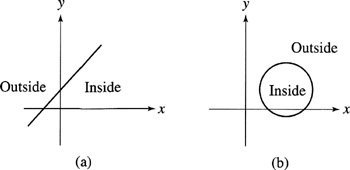
A straight line or open curve divides the Cartesian coordinate plane into two regions called halfspaces (Figure 7.1). One region we identify as the inside half (+) and the other as the outside half ( ?). A closed curve, such as a circle or ellipse, also divides the plane into two regions, one enclosed and finite and the other open and infinite. These are also examples of halfspaces.


Figure 7.1: Examples of halfspaces.

In three dimensions, a plane or surface divides space into two regions. These, too, are halfspaces and are sometimes called directed surfaces. This spatial division also applies to spaces of higher dimensions. An n-dimensional space is divided into halfspaces by a hypersurface of n ? 1 dimensions. We can combine two or more simple halfspaces using Boolean operators to create more complex shapes and to establish or limit the visibility of objects...

UNLIMITED FREE
ACCESS
TO THE WORLD'S BEST IDEAS

SUBMIT
Already a GlobalSpec user? Log in.

This is embarrasing...

An error occurred while processing the form. Please try again in a few minutes.

Customize Your GlobalSpec Experience

Category: Butterfly Valves
Finish!
Privacy Policy

This is embarrasing...

An error occurred while processing the form. Please try again in a few minutes.