Mathematics for Computer Graphics Applications, Second Edition

Just as with curves, we all have an intuitive sense of what a surface is. A surface is perhaps a little less abstract a concept than a curve, if only because we can actually touch the surfaces of the ordinary objects that fill our environment. It is light reflected off an object's surfaces that makes it visible. It didn't take long for mathematicians and computer graphics applications developers to realize that to create a convincing display of an object they had to thoroughly understand the mathematics of surfaces.
The parametric functions that describe a surface are somewhat different from those used for curves. Two independent parametric variables are required for surfaces, so the equations' general form looks like
Both parametric variables are usually limited to the unit interval 0 ? u, w ? 1, which is often expressed as u, w ? [0, 1]. This defines the simplest element of a surface, called a surface patch, or just patch. We model very complex surfaces by joining together several patches.
The simplest patch is a plane. The following equations define a plane patch in the x, y plane:
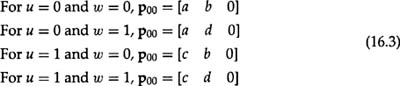
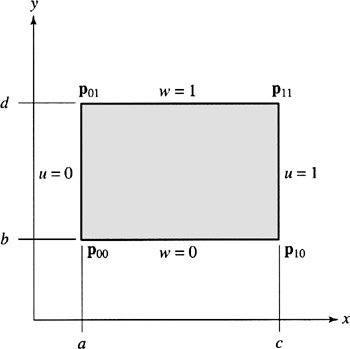
where u, w ? [0, 1] and a, b, c, and d are constant coefficients. Figure 16.1 illustrates this patch, which has some rather easy-to-identify characteristics. Its four corner points correspond to vectors whose components are defined by
The boundaries are, of course, straight lines derived when...