5.9 Intervals
There are two ways to define an interval between two points a and b on the real number line. Recall that the real number line is a straight line with one point on it, representing the origin or zero point, and two possible directions along it, one designated as positive and the other negative (Figure 5.23).
 Figure 5.23: The real number line.
 Each point on the figure corresponds to a real number whose absolute value is equal to the distance x of the point from the origin. The plus and minus signs indicate the direction to measure off this distance along the line.
We let the numbers a and b define the limiting or end points of an interval, where a < b.
An open interval does not contain the limit points, so we describe it by the expression
A closed interval does contain its limit points, so we describe it by the expression
Figure 5.24 shows both kinds of intervals.
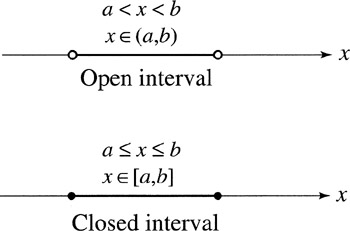 Figure 5.24: Open and closed intervals on the real number line.
 A shorter way to describe a closed interval looks like this: [ a, b], using brackets, with the interval limits separated by a comma. For an open interval we use parentheses, with the interval limits here, too, separated by a comma, as in ( a, b). We can also write for a closed interval
which we read as " x is an...


 TABLE OF CONTENTS