Mathematics for Computer Graphics Applications, Second Edition

To generate the computer graphics display of an object we apply a sequence of transformations to the points defining the object's geometric model. This sequence is usually best described by a set of matrices establishing a particular view orientation followed by a projection transformation matrix. We change our view of an object by changing these matrices.
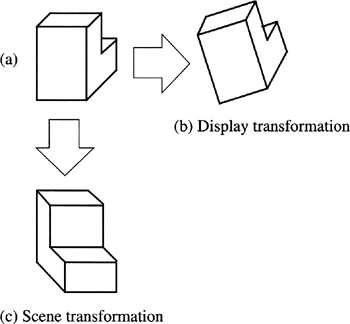
We distinguish between scene transformations and display transformations. Scene transformations are characteristically three dimensional and operate on model data to alter our point of view. Display transformations operate on the two-dimensional display data to change scale (zoom, for example) or to rotate the display around the line of sight. Figure 18.1 shows an example of this distinction. In (a) we see the displayed image of an L-shaped block. In (b) we see the image of the block rotated 30 about our line of sight. And in (c) we now see two new faces of the block, because our point of view has changed (a scene transformation).
The kinematic relationship between the observer and the scene is also something we must consider. Should the objects in the scene move, or should the viewer move? Should the transformations be relative to a fixed global axis, or relative to the current display axis? Once we transform and display an object, the next view of that object is produced by assuming that either the object itself moves or the view point moves. This difference is expressed by the algebraic...