Mathematics for Computer Graphics Applications, Second Edition

5.7: Tangent to a Curve

5.7 Tangent to a Curve

In the calculus, the derivative of a function has a geometric interpretation. It is the slope of the tangent to the curve (the graph) of that function. This means that the value of the derivative at any point on the curve is equal to the slope of the tangent line to the curve at that point. One way to find the tangent is to find the limiting position of a secant. We then visualize the derivative as the limit of the slope of a variable secant as one point of a curve moves into coincidence with another. This process describes the Fundamental Theorem of the differential calculus and its application to geometry.

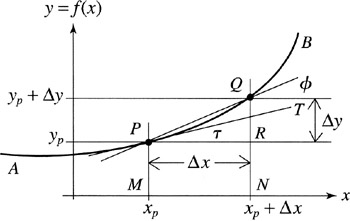
Now let's look at some details. We will find the tangent line to a curve at an arbitrary point P on it. Draw a secant through P and a neighboring point Q on the curve (Figure 5.20). Move Q along the curve so that it approaches closer and closer. This causes the secant line to revolve about P as it follows Q, until Q reaches its limiting position coincident with P. In this final position, the secant line lies on the tangent line at P.


Figure 5.20: Tangent to a curve.

Here, in four easy steps, is the algebra that corresponds to this geometry. Let y = f( x) be the equation of the curve AB, that is, the...

UNLIMITED FREE
ACCESS
TO THE WORLD'S BEST IDEAS

SUBMIT
Already a GlobalSpec user? Log in.

This is embarrasing...

An error occurred while processing the form. Please try again in a few minutes.

Customize Your GlobalSpec Experience

Category: Thermal Management Design and Analysis Services
Finish!
Privacy Policy

This is embarrasing...

An error occurred while processing the form. Please try again in a few minutes.