Matrices for Engineers

The formulation and solution of large systems of n algebraic equations in n unknowns (with n in the thousands and even the tens of thousands) can be handled expeditiously and efficiently by the modern, high speed, digital computer. The algorithms employed by the computer rely on an ordered methodology that is matrix oriented. Thus, a knowledge of the rudiments of the theory of matrices can prove to be most helpful and can provide an insight as to how a computer thinks.
However, the use of matrices and matrix theory is not restricted to the solution of systems of algebraic equations. There are many applications in pure and applied mathematics where one is confronted with rectangular arrays of variables and numbers. Matrix methods are employed in such diverse domains as structural analysis, the theory of elasticity, classical mechanics, electrical network analysis, control system synthesis and the analysis of mechanical vibration problems.
This chapter is devoted to preliminary concepts. These concepts will acquaint the reader with the terminology and permit the beginning of a serious study of the theory and use of matrices.
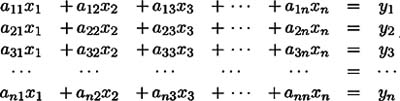
A system of n linear algebraic equations in n unknowns, x 1, x 2, x 3, ..., x n, such as
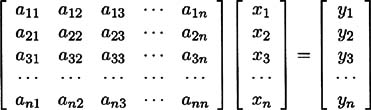
can conveniently be represented by the matrix equation
or more simply by
where A is a rectangular matrix (in this case square) having elements a ij and where X