Matrices for Engineers

Chapter 5: Simultaneous Equations

5.1 INTRODUCTION

Systems of linear, simultaneous algebraic equations occur quite often in engineering analysis of problems in all of the engineering disciplines. It has been observed in previous chapters that these systems of equations can be represented, in general, by


where A is a coefficient matrix, X is a column vector of solutions and B is a column vector of constants. If the system is "driven" by a set of variables, then the representation of the system of equations becomes


where Y is a column vector of the driving or forcing variables.

Many methods of solution exist. For example, a considerable amount of space has been devoted to a discussion of the inverse of a matrix. If the inverse of A exists, that is, if A is not singular, a solution for X has been observed to be


Of course, this study has indicated under what conditions the matrix A becomes singular. But what about the existence of a solution to AX = B and are there better methods of finding a solution? The answer to questions such as these and others is the subject of this chapter.

5.2 LINEAR DEPENDENCE AND INDEPENDENCE

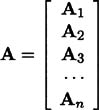
The coefficients in a set of linear, simultaneous algebraic equations can be represented as a set of row or column vectors, that is, in AX = B, the coefficient matrix, A, can be represented as


or as


Observe that all of these vectors have the same...

UNLIMITED FREE
ACCESS
TO THE WORLD'S BEST IDEAS

SUBMIT
Already a GlobalSpec user? Log in.

This is embarrasing...

An error occurred while processing the form. Please try again in a few minutes.

Customize Your GlobalSpec Experience

Category: Polarimeters
Finish!
Privacy Policy

This is embarrasing...

An error occurred while processing the form. Please try again in a few minutes.