7.1 INTRODUCTION
Matrix equations of the form
occur frequently in engineering analysis. Consider, for example, that the variables of interest in the analysis of a linear system are x 1,x 2 and x 3 and that they are related by three, linear, simultaneous differential equations with constant coefficients:
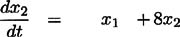
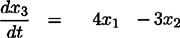
These may be solved for the derivatives
and then put into matrix form
The forgoing may be written with X indicating the derivative of X with respect to time as
where
The solution to the system of differential equations begins with the determination of the so-called complementary function. The procedure is to make the set of equations homogeneous and then, knowing that exponential solutions exist, assume that the complementary function is in the form x = Ce ?t where C is an arbitrary constant. Thus in
take X c = Ce ?t where C is a 3 1 column vector of arbitrary constants.
Then, with X c = ? Ce ?t it is observed that
which is in the form of eq (7.1) and where the values of the ?'s must be determined.
The forgoing discussion describes what is called the eigenvalve or characteristic value problem. It occurs frequently in engineering analysis in asll disciplines and it does not derive exclusively from a set of differential equations.
Consider the set of linear, simultaneous algebraic equations
in which the column vector of constants may...


 TABLE OF CONTENTS