Matrices for Engineers

Chapter 4: The Partitioning of Matrices

4.1 INTRODUCTION

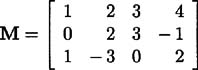
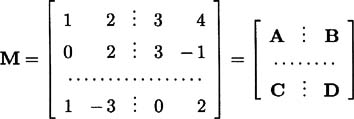
Computations with matrices of higher order can be helped dramatically if the matrices involved are partitioned, that is, divided into a number of smaller rectangular blocks or submatrices. The partitioning is usually indicated by dotted partitioning lines which must extend entirely through the matrix.

For example, the 3 4 matrix


can be partitioned into


where the matrices A, B, C and D are given by


and


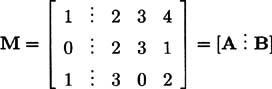
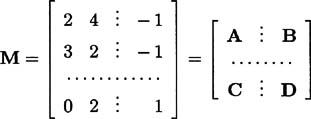
The arrangement of the partitioned matrices is not unique as the following examples [1] clearly show:


and


[1]Without regard to previous definitions.

4.2 ADDITION AND SUBTRACTION OF PARTITIONED MATRICES

Two matrices may be added or subtracted only if they are conformable for these operations; that is, they must be of the the same order. When matrices are partitioned, there is an additional requirement for their addition and subtraction. The matrices must be identically partitioned; that is, the partitioned matrices must be partitioned such that the corresponding individual matrices within the partitions are of the same order. For example, if M and N


are to be added then A and E, B and F, C and G and D and H must all be of the same order.

Example 4.1

If it is desired to add M which is partitioned into four submatrices, A, B, C and D as indicated,


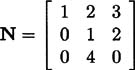
to N


then N must also be partitioned into four submatrices, E, F, G and H

UNLIMITED FREE
ACCESS
TO THE WORLD'S BEST IDEAS

SUBMIT
Already a GlobalSpec user? Log in.

This is embarrasing...

An error occurred while processing the form. Please try again in a few minutes.

Customize Your GlobalSpec Experience

Category: Supercapacitors
Finish!
Privacy Policy

This is embarrasing...

An error occurred while processing the form. Please try again in a few minutes.