Matrices for Engineers

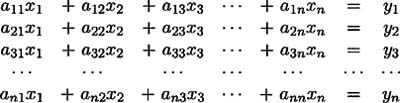
The n th order set of simultaneous, linear algebraic equations in the n unknowns, x 1,x 2,x 3,...,x n,
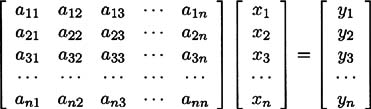
can conveniently be represented by the matrix equation
or more simply by
where A, as indicated in Section 1.2, is a square matrix of coefficients having elements a ij and where X and Y are n 1 column vectors with elements x and y, respectively.
Because division of matrices is not permitted, one method for the solution of matrix equations such as the one shown in eq (3.1) is called matrix inversion.
If eq (3.1) is premultiplied by an n n square matrix B so that BAX = BY, a solution for the unknowns, X, will evolve if the product BA is equal to the identity matrix I
or
If
the matrix B is said to be the inverse of A
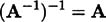
and, of course, the inverse of the inverse is the matrix itself
or
It may be recalled that, in general, matrix multiplication is not commutative. The multiplication of a matrix by its inverse is one specific case where matrix multiplication is commutative
The inverse of a product of two matrices is the product of the inverses taken in reverse order. This is easily proved. Consider the product AB and postmultiply by B ?1A. Because...