Metal Forming Analysis

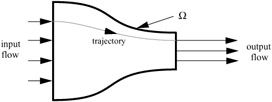
Theoretically, steady-state flow is fully established in a given domain ? when, for any spacial point in ?, all the mechanical and physical variables that are necessary to describe the problem are independent of time t. Of course, the position of a material point is not constant, but follows a fixed trajectory as shown in Fig. 9.1.
From the practical point of view, the steady-state idealization is always an approximation, as a true stationary flow would require an infinite time to be established. However, in industrial processes such as rolling, extrusion, drawing, and so on, the steady-state assumption is a rather accurate approximation as soon as the length of the deforming zone is less than half of the rigid parts lying before or after this zone. At this stage the end effects, that is, the discrepancies from the stationary shape that occur at the beginning and at the end of the process, have a vanishingly small influence on the flow. In the sheet-rolling process, the length of the deformed zone is of the order of a few centimeters, and the length of the rolled sheet is several hundred meters. Conversely, during the extrusion process, the length of the billet is only of the order of ten times the diameter so that the steady-state part of the process is more approximate, and represents a smaller percentage of the whole process.
When it is possible, the stationary hypothesis can be tested...