Metal Forming Analysis

The evaluation of external forces (contact and friction) requires the definition of a contact normal direction and contact tangential direction. The stiffness matrix requires the derivatives of these directions with respect to nodal positions.
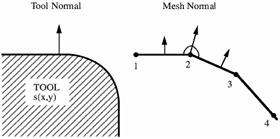
The almost-universal approach taken by FEM programmers for sheet-analysis programs is shown on the left side of Fig. 11.4; this is the "tool-normal" approach. The surface description of the tool surface is used to find the normal, tangent, their derivatives, and perhaps the surface curvatures in terms of spatial coordinates at a point where a contact node is located. Since these quantities depend only on the position of the contacting node, the terms appear only on the diagonal of the stiffness matrix.
After 1988, a different approach was taken in developing SHEET-S and SHEET-3, as shown on the right side of Fig. 11.4. We call this the "mesh-normal" approach, where all of the geometric information used in formulating the external forces is derived from the FEM mesh, not from the tooling description. In this approach, the normal is defined by the positions of connecting nodes, so the normal, tangent, and derivatives depend on these nodal positions. The programming is significantly more lengthy, but there are several major advantages.
Figure 11.5 shows the normal vectors and forces calculated from the tool surface (n T) and the FEM mesh ( n m). The...