Metal Forming Analysis

The SHEET-S and SHEET-3 programs described in some detail above have been used for a variety of applications during the past 10 years. While the individual references should be consulted for details of the simulation techniques and the results, a few brief examples may be useful in illustrating the range of capability. In addition, several examples of in-plane simulations of forming tests were presented. These simulations were carried out by using an in-plane version, SHEET-2, of a program with features similar to SHEET-S and SHEET-3.
One of the important choices in FEM analysis centers on the assumed symmetry of the geometry, such as tooling, workpiece properties, and boundary conditions. It is possible in many cases to reduce the size and complexity of a problem greatly by using special assumptions such as axisymmetry or plane strain. Axisymmetric and plane-strain symmetries are very similar in formulation, implementation, and execution time.
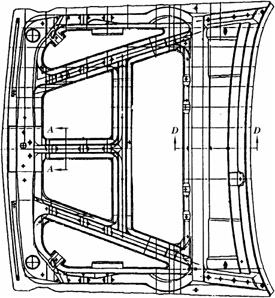
On one hand, most stamping operations require a three-dimensional model. On the other hand, there are local sections in a complex stamping (see sections A-A or D-D in Fig. 11.20) where the forming operation can be usefully simulated by a two-dimensional plane-strain sectional analysis. The two-dimensional procedure is strictly accurate only for the forming operations that have long regions of constant cross section.
Numerically stable two-dimensional computer codes have been used...