Metal Forming Analysis

11.2: Elements Used in SHEET-S and SHEET-3

11.2 Elements Used in SHEET-S and SHEET-3

We now begin to outline the procedures and algorithms used in SHEET-S and SHEET-3: static implicit, rigid viscoplastic, finite-element programs for two- and three-dimensional analyses of sheet-forming operations.

Plane-Strain Line Element

For a section analysis like that performed by SHEET-S, a plane-strain line element [5] is the simplest one, as shown in Fig. 11.1. The longitudinal strain increment, ? ? l, during the incremental time step can be written as

(11.1)

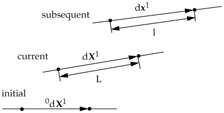
where L and l are respectively element lengths in the current and subsequent configurations, expressed in the x- z plane in terms of nodal coordinates, as defined in Fig. 11.1:

(11.2)
(11.3)

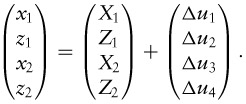
The nodal coordinates are related by the incremental displacement, ?u.

(11.4)

or

(11.5)

Figure 11.1: Definition of material line vectors at time t = 0, t = t 0, and t = t 0 + ?t for a line element.

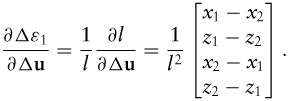
The derivative of the strain increment, ? ? 1, with respect to the incremental displacement ? u, is needed to find the internal force for equilibrium. The required form can be obtained from Eqs. (11.4) and (11.5) as follows:

(11.6)

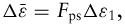
In plane-strain analysis, and either rigid plasticity (or ignoring elastic volume change), the strains are simply related: d ? 1 = ?d ? 3, d ? 2 = 0. For any yield function with isotropic hardening, we can write

(11.7)

where we define F ps

UNLIMITED FREE
ACCESS
TO THE WORLD'S BEST IDEAS

SUBMIT
Already a GlobalSpec user? Log in.

This is embarrasing...

An error occurred while processing the form. Please try again in a few minutes.

Customize Your GlobalSpec Experience

Category: Vacuum Gauges and Instruments
Finish!
Privacy Policy

This is embarrasing...

An error occurred while processing the form. Please try again in a few minutes.