11.4 Equilibrium Equation
Mechanical equilibrium is achieved by satisfying the equilibrium condition [12] of internal force and external force at each node. Namely, the internal force must be balanced with the external force. The force equilibrium condition also can be derived from an approximation of the classical virtual work theorem. More details were presented in Chapter 3. Since the two forces all depend on the incremental displacement, ? u, during a time step, the equilibrium equation can be expressed as
| (11.63) |  |
where the subscripts I and E stand for internal and external, respectively. For each node, Eq. (11.63) can be written as three equations in component form in the x, y, and z directions.
For a given yield function, the internal equivalent work is
| (11.64) |  |
where ?, ?, and  denote the effective stress, strain, and the strain rate, respectively. The effective stress is generally a function of current effective strain and effective strain rate, depending on the hardening law chosen. The incremental effective strain ? ?, whose definition depends on choice of yield function, is defined as the change of the effective strain over the time step ?t:
| (11.65) | 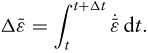 |
Adopting an assumption of a proportional path within an incremental time step, we find the increase of the effective strain is a fixed function of the principal values of the incremental strain tensor (as long as an explicit effective strain equation is available for a given yield function):
| (11.66) |  |
where ?


 TABLE OF CONTENTS