Newton Iteration and Line Search Algorithm
Chapter 3 introduced the Newton-Raphson method for solving a nonlinear system. Equation (11.86) defines a set of nonlinear equations to be linearized for solution by this method.
The N-CFS algorithm introduces one more variable to the basic variable at each node. Now the generalized nodal variable is represented by a vector ? r:
| (11.98) | 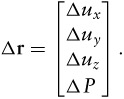 |
By using this generalized variable, we can express the global equilibrium and contact condition in a compact form:
| (11.99) |  |
The generalized internal force vector R I and R E for a general node k can be defined respectively as
| (11.100) | 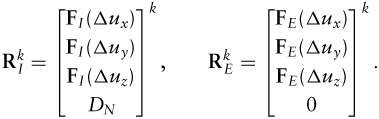 |
With the use of the Newton method, the stiffness equation becomes
| (11.101) |  |
where the K is the tangent stiffness matrix and ?? r is a correction vector that will be zero at the end of a time step if convergence is achieved. Letting superscript i denote the current iteration number, we express the stiffness equation in iteration i by rewriting Eq. (11.101) as
| (11.102) |  |
where only the ?? r is unknown. The correction rule during the iteration is expressed as
| (11.103) |  |
where 0 ? y ? 1, and the accumulation rule after convergence at the end of a time step is (note that the step number is denoted by a presuperscript, while the iteration number by a postsuperscript)
| (11.104) |  |
In the N-CFS algorithm, if the contact status of a node is changed from contact to free,...


 TABLE OF CONTENTS