Microstrip and Printed Antenna Design

Written for practicing engineers new to the field, this book includes a succinct treatment of wireless designs with enough detail that CAD formulas may be implemented with relative ease.
 TABLE OF CONTENTS
 Microstrip geometries which radiate electromagnetic waves were originally contemplated in the 1950's. The realization of radiators which are compatible with microstrip transmission line is nearly contemporary with its introduction in 1952 by Grieg and Englemann. [1] The earliest known realization of a microstrip like antenna integrated with microstrip transmission line was developed in 1953 by Deschamps. [2] By 1955 Gutton and Baissinot patented a microstrip antenna design. [3]
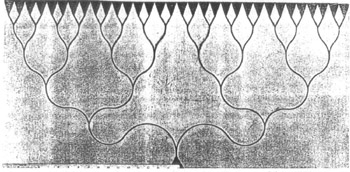
Early microstrip lines and radiators were specialized devices developed in laboratories. No commercially available printed circuit boards with controlled dielectric constants were developed during this period. The investigation of microstrip resonators which were also efficient radiators languished. The theoretical basis of microstrip transmission lines continued to be the object of academic inquiry. [4] Stripline received more interest as a planar transmission line at the time because it supports a TEM wave and allowed for easier analysis, design and development of planar microwave structures. This may have been the one of the reasons microstrip did not achieve immediate popularity in the 1950s
The development of microstrip transmission line analysis and design methods continued in the mid to late 1960s by Wheeler [5] and Purcel et al. [6] [7] In 1969 Denlinger noted rectangular and circular microstrip resonators could efficiently radiate. [8] Previous researchers had noted that in some cases 50% of the power in a...