Microwave Differential Circuit Design Using Mixed Mode S-Parameters
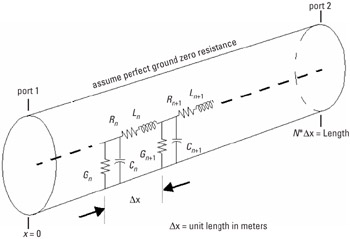
Scattering parameters or power-based (large-signal) scattering parameters are widely used in the RF and microwave fields to represent circuits and devices with distributed elements such as coax transmission lines. A distributed element can be implemented, modeled or analyzed as a large set of basic unit length structures connected in series. Although each basic element may be approximated as a lumped circuit, the cascading of a sufficient number of basic elements gives distributed circuit characteristics (see Figure 3.1). The application of an incident-electromagnetic signal-wave stimulation to a distributed-circuit terminal results in a scattering or separation of the signal into reflected-electromagnetic and transmitted-electromagnetic waves. Scattering-wave descriptions of circuit networks are very important when operating at frequencies that are high enough that circuit-element-electrical-transmission lengths become a significant fraction of a wavelength (approximately one-tenth of a wavelength). Scattering parameter techniques originate from transmission-line concepts and are defined with respect to a transmission-line-characteristic impedance, or reference impedance. The primary benefit of s-parameters is the ease of measurement compared to voltage or current derived Z- or H-parameters. Device s-parameters are measured with all ports terminated in the characteristic impedance rather than short-circuit or open-circuit terminations. At RF and microwave frequencies short-circuit and open-circuit terminations are impractical. In general, physical implementations of microwave and RF distributed circuit designs, models, analyses or systems must be related to s-parameter test data at some point in the design cycle. Thus, s-parameter measurements and theory drives the design and test of microwave circuits, devices, and products.