Microwave Differential Circuit Design Using Mixed Mode S-Parameters
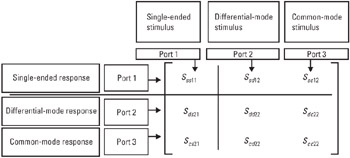
The Wilkinson splitter/combiner microwave response was determined long ago. The reader can gain new insights into an optimized Wilkinson splitter-design procedure with the use of mixed-mode s-parameters. The splitter/combiner shown in Figure 5.3, has one single-ended port and one mixed-mode port composed of single-ended ports 2 and 3. An ideal splitter would have one single-ended input port and two single-ended output ports with an equal amplitude and a fixed phase offset at the output signals. A 3 3 s-parameter matrix composed of one single-ended port and a second mixed-mode port is shown in Figure 5.4.
The s-parameter port reflection or return loss terms, S ss 11, S dd 22, and S cc 22 are the single-ended and mixed-mode s-parameters representing the impedance matching at the ports in Figure 5.4. S ss 11, S dd 22, and S cc 22 zero magnitude values result from perfect port matching. The incident-power wave is absorbed into a port that is perfectly matched (infinite return loss). A perfect match for normalized s-parameters is usually 50 ? for a single-ended port, 25 ? for a common-mode port, and 100 ? for a differential port. The magnitude of the maximum reflection is 1 and it represents a complete mismatch (open or short); the entire incident-power wave is reflected and none of the power is absorbed into the device port. The network of...