Microwave Differential Circuit Design Using Mixed Mode S-Parameters
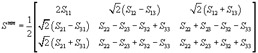
The next step is to expand the mixed-mode s-parameters in terms of single-ended standard s-parameter to gain additional insight into the Wilkinson 3-dB 0 splitter/combiner design, optimization, and application. Equation (5.3) shows the mixed-mode s-parameters in terms of the single-ended standard s-parameters. The derivation details are reviewed in a later section in this chapter.
| (5.3) | |
An initial review of the upper-left term of (5.3) demonstrates a direct connection between S 11 and S ss 11, the splitter/combiner single-ended port. Each port 1 to mixed-mode parameters conversion term ( S ds 12, S cs 12, S sd 21, and S sc 21) is defined as a sum or difference of the single-ended transmission s-parameters ( S 12, S 13, S 21, and S 31) with a half-power magnitude. These terms are in the top row and the left-most column, excluding the upper-left term (see Figure 5.4). While the pure mixed-mode and cross mixed-mode s-parameters ( S dd 22, S cc 22, S dc 22, and S cd 22), are each built with all four single-ended port 2 and port 3 s-parameter terms ( S 22, S 23, S 32, and S 33). These mixed-mode parameters are the 2 2 submatrix terms of the lower right of the matrix of (5.3).
A lossless 90 splitter/combiner would have ideal standard s-parameters equal to the values shown in (5.4). The...