Microwave Differential Circuit Design Using Mixed Mode S-Parameters
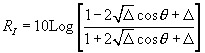
Frequency converters (mixers) are fundamental RF components in which 0 , 90 , and 180 single-ended to mixed-mode and reverse signal conversions are extensively applied. The accuracy of the RF signal processing directly effects specifications such as port-to-port isolation, spurious rejection, side-band suppression, and even-order distortion. Image-rejection mixers perform spurious harmonic rejection; the level of image-signal rejection relative to the intended signal (down) conversion is a function of the mixer amplitude and phase imbalance across the entire frequency range. The following relationship can be used to determine downconverter or receiver mixer-image rejection ( R I) or upconverter transmitter side-band-signal suppression as a function of amplitude ( ?) and/or phase ( ?) imbalance.
| (5.60) | |
The amplitude and phase imbalance values are modeled as a composite value across the entire frequency-conversion range, not just at the input single-ended to mixed-mode signal transfer frequency. Mixers are sensitive to the fundamental signal and all other signals injected into the mixer-input-frequency band. To achieve -20 dBc of receiver image rejection or transmitter sideband suppression requires less than 10 of image rejection mixer phase imbalance and less than 0.8 or -1 dB of amplitude imbalance. One implementation of an image-balanced mixer is shown in Figure 5.25, where a 90 hybrid is used in the RF and LO path and a 0 or 180 signal splitter is used in the IF path. An alternative image-rejection mixer would have the 90 hybrid in the IF path and a 0 signal splitter in the...