Microwave Field-Effect Transistors: Theory, Design, and Applications

Chapter 3: GaAs FET Theory-Power

3.1 Introduction

The low noise and small signal properties of GaAs MESFET's have been the subject of the previous chapter. In contrast to the low noise device the power FET has only recently started to receive attention from theoreticians. The outcome of such studies is now beginning to show in the results of power, efficiency and reliability of power FETs at frequencies up to 20 GHz.

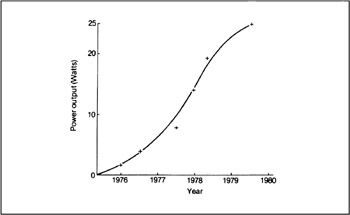
For example the progress of power obtained from GaAs FETs as a function of time is shown in Figure 3.1 where the results of several companies have been collected together.


Figure 3.1: Progress of Power Obtained from GaAs FETs as a Function of Time

Power FETs with output powers in excess of 2 watts at 12 GHz are available commercially and over 5 watts has been achieved in the laboratory.

This chapter will review the operating principles of the power GaAs FET and discuss the various structures that are being used to increase device performance. The large signal performance of the device will be analyzed together with its third order intermodulation distortion and gain compression characteristics.

3.2 Principles Of Operation

As has been seen in Chapter 2, Shur (1978) and Shur and Eastman (1978) have modeled the GaAs FET as a device where a Gunn domain forms at the drain contact thus effecting the current saturation and breakdown voltage of the FET. Recently, Willing et al (1978) have considered the power performance of the FET by calculating the large signal performance from the experimentally...

UNLIMITED FREE
ACCESS
TO THE WORLD'S BEST IDEAS

SUBMIT
Already a GlobalSpec user? Log in.

This is embarrasing...

An error occurred while processing the form. Please try again in a few minutes.

Customize Your GlobalSpec Experience

Category: Bipolar RF Transistors
Finish!
Privacy Policy

This is embarrasing...

An error occurred while processing the form. Please try again in a few minutes.