Microwave Field-Effect Transistors: Theory, Design, and Applications
Chapter 9: Novel FET Circuits

9.1 Introduction

This chapter is intended as an introduction to the use of GaAs FETs in circuit roles other than the usual ones of amplification, oscillation and frequency conversion. Both single and dual gate FETS, whether they be low noise or power devices have been used successfully in a variety of microwave applications such as switches, attenuators, phase shifters and modulators. The introduction of monolithic circuits, dealt with in more detail in Chapter 10, has enabled many of these circuits to be fabricated on single chips of GaAs. However, many of the circuits have also been implemented using bare chip FETs and hybrid microstrip techniques (Pengelly et al, 1980).

9.2 Switches

For many years the PIN diode as a control element has dominated microwave circuits such as switches and phase shifters (Graver, 1972). However, recently the use of both single and dual-gate FETs has received considerable attention in the design of fast switches.

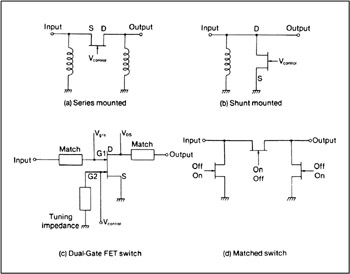
Several configurations are possible to exploit the low-noise small signal and the power FET as switches (Figure 9.1). The series configuration (Figure 9.1(a)) makes use of the saturation and pinch-off conditions of the device and provides a broadband (untuned) response with zero d.c. bias power when using small signal devices.


Figure 9.1: Various FET Switch Configurations

The use of the series configuration to switch medium levels of r.f. power (i.e. a few watts) can be achieved using a power FET structure. However, such a configuration produces poor frequency response due to the capacitance between the source and...

UNLIMITED FREE
ACCESS
TO THE WORLD'S BEST IDEAS

SUBMIT
Already a GlobalSpec user? Log in.

This is embarrasing...

An error occurred while processing the form. Please try again in a few minutes.

Customize Your GlobalSpec Experience

Category: Bipolar RF Transistors
Finish!
Privacy Policy

This is embarrasing...

An error occurred while processing the form. Please try again in a few minutes.