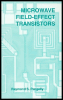
Microwave Field-Effect Transistors: Theory, Design, and Applications
The 1960's saw the development of first practical microwave solid state sources such as transferred-electron device and IMPATT diode oscillators and the extension of bipolar transistor oscillators to microwave frequencies. The development of GaAs MESFET devices in the early 70's has significantly influenced the choice a system designer has to make on the selection of a microwave power source.
The transferred electron or the Gunn oscillator, which has been the mainstay for low power solid-state oscillator applications, suffers from two main drawbacks. One is the low d.c. to r.f. conversion efficiency and the other is the threshold current requirement, both of these resulting in higher d.c. input power consumption. Low operating efficiency also means that the Gunn device works at high temperatures, unless the heat can be removed effectively. The GaAs FET oscillator provides a higher d.c. to r.f. conversion efficiency (>10%) and does not have any threshold current requirements. Being a three terminal structure the GaAs FET is an extremely versatile active oscillator circuit element and by making use of this feature it is possible to control the behavior of the oscillator to provide modulation, compensation and stabilization etc.
The GaAs FET oscillator activity has received much attention in the recent years. High efficiency fixed frequency oscillators have been reported in the literature for frequencies up to 25 GHz and beyond. Electronic tuning of FET oscillators by YIG resonators and varactor diodes has been extensively researched. As most GaAs FET oscillators are realized in low Q microstrip...