Mobile Telecommunications Factbook
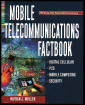
Get up to speed quickly and painlessly on everything wireless from PBX to PHS!
 TABLE OF CONTENTS
 As the term would suggest, mobile messaging refers to the ability to send and receive messages between individuals or groups, regardless of their location. The messages can take several forms, including text, voice, image (i.e., facsimile), and video. Depending on the tools used to send and receive messages, several different communications formats can be combined in the same message making it a multimedia message.
There are many types of appliances that can be used to receive these messages. Certain pagers, for example, can only read the number of the person to call back, while others can handle text messages and allow the recipient to acknowledge receipt with a predefined courtesy message. More recently, pagers have become available that send and receive voice messages. Mobile phones are being equipped with more functionality as well, enabling them to receive pages, e-mail, and faxes.
While most messaging is not a real-time activity, it can be. For example, two or more people may connect at a designated server on the Internet to chat. Chatting is the real-time transmission and receipt of text messages. While individuals are chatting, they can also transfer files or send e-mail to each other. Some Internet telephony software includes a chat capability, enabling some participants to alternatively converse or chat as circumstances dictate.
With so many diverse ways of communicating, managing the information has become a serious problem, particularly for mobile professionals. Fortunately, new tools are becoming available that consolidate messages from various sources into one "inbox" so they can...