Mobile Telecommunications Factbook
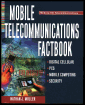
Get up to speed quickly and painlessly on everything wireless from PBX to PHS!
 TABLE OF CONTENTS
 There are many kinds of e-mail systems in use today. There are the internal client/server e-mail systems used by corporations, which operate over local area networks (LANs). There are also mainframe/minicomputer-based e-mail systems in the corporate environment, but these legacy systems have largely given way to client/server e-mail systems with the transition to LANs. Online services and Internet service providers offer e-mail accounts as part of the subscription price for bulletin board and/or Web access. These services are used by both consumers and corporations. There are also public e-mail services that are offered by telephone companies and long distance carriers, as well as wireless service providers.
Electronic mail enhances business transactions by replacing paper forms and manual delivery systems with faster, more reliable computer communications. With information stored in digital form and conveyed electronically between computers and other communications devices such as personal digital assistants (PDAs), pagers and wireless phones messages can be easily edited and integrated into other applications. Just as important, e-mail can be accessed virtually anywhere, anytime. In addition to various wireless services that make this possible, mobile professionals can access and manage their e-mail through the Internet.
The primary advantage of a wireless e-mail service is that it eliminates the need for mobile professionals to find a phone and attach a coupler to it. Since a two-way wireless messaging service operates through the airwaves, there is never any need for a phone connection. All that is needed is a portable computer equipped with a radio modem,...