Mobile Telecommunications Factbook
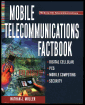
Get up to speed quickly and painlessly on everything wireless from PBX to PHS!
 TABLE OF CONTENTS
 Current, first-generation cellular systems are based on the same analog FM radio technology that has provided wireless voice communication for more than a decade, during which demand has finally caught up with the available capacity. There are two approaches to rectifying the problem: install new digital cellular systems to add capacity in the local loop, which is expensive; or enhance existing analog systems with digital technology to increase the capacity, which is more economical. Complicating matters is that the technologies used in each approach, Code Division Multiple Access (CDMA) and Time Division Multiple Access (TDMA), respectively, are not compatible with each other.
The current FM radio divides the spectrum into 30-kHz channels, with one user assigned to each channel. In frequency division multiple access (FDMA), the 30-kHz channel can be divided into three narrower channels of 10 kHz each. However, this band-splitting technique incurs significant base station costs and its limited capacity makes it suitable only as a short-term solution in areas of limited growth, or in situations where the service provider wants to extend the useful life of existing analog equipment.
Alternative means of channelization TDMA and CDMA can support more users in the same region of the spectrum. In fact, TDMA and CDMA (and their derivatives) are the primary technologies contending for acceptance among cellular carriers.
TDMA systems have been providing commercial cellular service since mid-1992 and the technology is the foundation for such telecommunications standards as GSM, PHS, and PACS.