Mobile Telecommunications Factbook
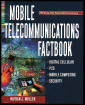
Get up to speed quickly and painlessly on everything wireless from PBX to PHS!
 TABLE OF CONTENTS
 Most computers in the corporate environment are tied together over wired LANs so that users can access and share data, applications, and services. However, a growing number of applications require mobility as well as network access. One way of achieving both objectives is for a notebook computer to plug into a docking station, which is wired to the LAN. Another way is for the notebook's PCMCIA card to establish a wireless connection to the nearest access point, which is wired to the LAN. Of course, desktop computers can be interconnected with each other over a wireless LAN, and connect to a wired LAN only when necessary through an access point. A network interface card (NIC) equipped with a transceiver links individual network nodes. External antennas allow for omnidirectional transmission instead of requiring a clear line of sight.
Coverage can be extended to other floors, between buildings, or across a metropolitan area using wireless bridge/routers. Since it is not necessary to install new cabling, wireless LANs offer a convenient alternative for adding or moving users. Both Ethernet and token ring LANs are supported over wireless links and the devices can be managed using standard SNMP-based management packages or vendor-specific configuration tools.
Notebook and desktop computers are not the only devices that require wireless connections. Mobile terminals PDAs, specialized handheld terminals, and barcode scanners connected to wireless LANs are being increasingly used to enhance business operations. Mobile data applications are raising the productivity of essential personnel and eliminating unnecessary paperwork, cutting operations costs...