Mobile Telecommunications Factbook
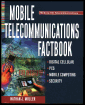
Get up to speed quickly and painlessly on everything wireless from PBX to PHS!
 TABLE OF CONTENTS
 Mobile professionals have a plethora of messaging tools and techniques to choose from, each fulfilling a different need. The specific products and services available to meet these needs are numerous and varied, differing in terms of performance, connectivity, protocols supported, features, and user-friendliness. There is a trend toward convergence, both in terms of hardware and software. With this convergence comes an opportunity to better manage communications in all its forms.
As we continue to move beyond real-time telephone conversations to rely on voice messaging, fax, and e-mail, the ability to receive and manipulate various types of messages through a single device becomes increasingly important. Universal messaging provides a single view of all voice, fax, and e-mail messages. This means subscribers are no longer forced to delete voice messages through the handset interface and e-mail messages through the workstation interface. Such activities can be performed across all message types from any user interface. The synchronized management of messages can be supported through handset or browser commands so that, among other things, messages deleted through one interface become unavailable through other interfaces as well.