Motors & Drives: A Practical Technology Guide

In the most generic sense, a drive is a device that controls speed, torque, direction, and the resulting horsepower of a system. There are many different types of drives, and they will be discussed later in this chapter. For now, we will focus on the reasons for drive use in our industrial and commercial environments. To appreciate the use and benefits of any type of drive, we need to look at a generic application and determine how the system could be improved.
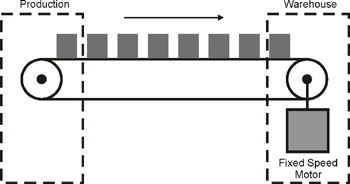
Figure 1-1 shows a prime candidate for a variable-speed drive a conveyor in a manufacturing plant.
In Figure 1-1, we can see that the conveyor's main intent is to move products from production to the warehouse. A typical way to move products is by means of a motor. The generic motor on this conveyor operates at only one speed. With only one speed of motion, this type of manufacturing system has its drawbacks.
The products can reach the warehouse only in a given timeframe. There is no way to gradually increase the conveyor speed. If it takes the motor a very short time to accelerate, the boxes may fall off the conveyor because of the accelerating forces. We will look at several factors that lead to the use of a variable-speed drive: efficiency gains, process changes and improvements, and system coordination.
We may view the system in Figure 1-1 as very inefficient. We are locked into whatever efficiencies the motor...