Motors & Drives: A Practical Technology Guide

The following information is a summary of typical formulas and conversion factors used in the rotating machinery industry. This information can be used as a basis for sizing drives and evaluating application types and factors.
However, these formulas are to be used for estimating purposes only. They do not include allowance for machine friction, windage, or other machine factors. When sizing a drive, always consider all machine factors (i.e. electrical, mechanical, and environmental) and motor factors (e.g., full load amperes and speed range).
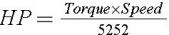
where:
| Torque | = lb-ft |
| Speed | = rpm |
| 5252 | = a proportional constant |
where:
| Force | = force or weight (lb) |
| Velocity | = fpm |
where:
| Force | = force or weight (lb) |
| Velocity | = fpm |
where:
| BHP | = |
| CFM | = cubic feet per minute |
| EffofFan | = efficiency of fan (%/100) |
| Pressure | = lb/ft 2 |
where:
| BHP | = |
| CFM | = cubic feet per minute |
| EffofFan | = efficiency of fan (%/100) |
| Pressure | = lb/in 2 |
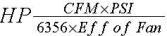
where:
| CFM | = cubic feet per minute |
| EffofFan | = efficiency of fan (%/100) |
| PSI | = pressure in inches of water |
where:
| BHP | = |
| GPM | = gallons per minute |
| Head | = measurement of pressure in ft |
| EffofPump | = efficiency of pump (%/100) |
| SpecificGravity | = 1.0 (water) |
| Efficiency of pump (positive displacement) may vary between 50 and 80% depending on size | |
| Efficiency of pump (centrifugal) | = 500 to 100 GPM = 70 to 75% 1000 to 1500 GPM = 75 to 80% Over 1500 GPM = 80 to... |