In this section, open- and closed-loop control will be reviewed. Most of the information has been previously presented. However, the focus of this chapter will be on the external devices that connect to the drive. These external components allow the drive to interface to a system and provide the necessary speed and torque control to maximize efficiency.
External devices (peripherals) are a vital part of any drive system whether operating as part of a remote operator station or part of an entire production system. There is such a wide variety of peripherals that are used in drive control that to include all possible combinations would be beyond the scope of this book. However, the major categories of devices and their use will be covered in this chapter.
Open-Loop Control
Open loop control was presented in Chapter 4, under the direct current (DC) and alternating current (AC) drive sections. A brief review is given here. Figure 5-1 indicates the basics of open-loop control.
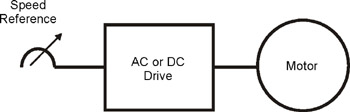 Figure 5-1: Open-loop control
 The open-loop control is the simplest form of drive control. The drive operates the motor, given the speed reference that is delivered from the hand speed pot. If Figure 5-1 were of a DC drive, motor-speed regulation would be 5 7% higher. If the figure were of an AC drive, motor-speed regulation would be 3 5% higher, possibly higher depending on motor design.
Open-loop control is more typical in AC drives, where the inherent motor-speed regulation is acceptable in the 3 5% range. DC drives are almost...
Copyright ISA - The Instrumentation, Systems, and Automation Society 2003 under license agreement with Books24x7


 TABLE OF CONTENTS