Motors & Drives: A Practical Technology Guide

Up to this point, basic drive theory, component hardware, and interface devices have been discussed. It is now time to put the basics to work to develop a drive system. The following information will help tie the components together into a coordinated control system. All systems configurations would be closed loop because of the precise speed and torque regulation required.
In actuality, there would be many more pieces to the system "puzzle" than what is presented here. However, this section is meant to present a general outline of drive systems and how the pieces work together in an automated environment.
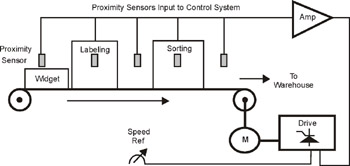
It is helpful to start with what could be considered a "simple" system and move to the more complex. Figure 6-1 indicates one such simple closed-loop system.
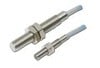
As seen in Figure 6-1, this is a "widget" manufacturing facility. This section is the "finishing" section of the system, with proximity sensors strategically placed along the out-feed conveyor. All of the sensors are connected to an amplifier unit that sends contact signals to the drive. The drive needs to know where the widget is at all stages of the system. Therefore, the job of the proximity sensor is to send a contact closure signal to the drive. This would be considered a digital input (DI). In this case, the drive does not need to know how big, or how long the widget is, just that fact that it has arrived at...