Network Cabling Handbook

As the network technician's ideal go-to reference, this one-stop guide to both copper and fiber network cabling contains detailed coverage of monitoring software, connectivity, troubleshooting, and management techniques.
 TABLE OF CONTENTS
 Copper cables can be used for both horizontal and backbone media types. Large multipair UTP cables are used for backbone applications. Smaller, four-pair cables are installed for horizontal applications.
Horizontal cables are installed from the telecommunications room (TR) to the work area. These cables can be installed in a cable pathway that can run either below the floor or above the ceiling. Horizontal cables can also be installed above the ceiling of a building in the open space between the ceiling and the roof. This chapter will describe how to install copper horizontal cables.
The ANSI/TIA/EIA-568-B.1 standard released in 2001 supports the following media types in the horizontal subsystem for new cable installations (see Figure 18-1):
| ? | 100-ohm UTP cable |
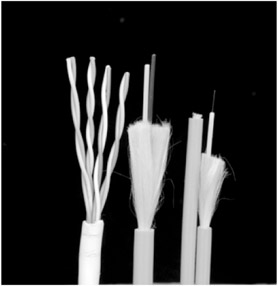
| ? | 62.5/125 ?m multimode optical fiber cable |
| ? | 50/125 ?m multimode optical fiber cable |
One-hundred ohm UTP copper cables are the primary type of media installed for the horizontal subsystem (see Figure 18-2). These types of cables are preferred because most applications can be supported over UTP cable. Voice systems were the first to work over UTP cable. High-speed local area networks (LANs) were modified to operate over data grade UTP cables. This is the reason that the ANSI/TIA/EIA-568-B.1 standard recommends that a minimum of two cables be installed to each work area. One cable should be a category 3 UTP cable for voice applications and the other should be a data grade category 5e or...