Optical Communications Essentials

8.3: Fiber-Related Losses

8.3 Fiber-Related Losses

In addition to mechanical misalignments, differences in the geometric and waveguide characteristics of any two mated fibers can have a profound effect on the joint loss. The differences include variations in core diameter, core-area ellipticity, numerical aperture, and core-cladding concentricity of each fiber. Since these are manufacturer-related variations, the user has little control over them, except to specify certain tolerances in these parameters when purchasing the fiber. For a given percentage mismatch between fiber parameters, differences in core sizes and numerical apertures have a significantly larger effect on joint losses than mismatches in the refractive-index profile or core ellipticity.

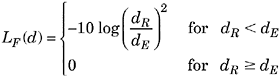
Core area mismatches. For simplicity let the subscripts E and R refer to the emitting and receiving fibers, respectively. If the axial numerical apertures and the core index profiles are equal [that is, NA E(0) = NA R(0) and ? E = ? R], but the fiber diameters d E and d R are not equal, then the coupling loss is

(8.8)

Core area mismatches can occur when one is trying to connect a 62.5- m fiber to one with a 50- m core, for example. In this case, going from the larger to the smaller fiber results in a 1.9-dB loss, or 36 percent of the power. A much more serious loss occurs when one inadvertently tries to couple light from a multimode to a single-mode fiber. For example, if one connects a 62.5- m multimode fiber to a...

UNLIMITED FREE
ACCESS
TO THE WORLD'S BEST IDEAS

SUBMIT
Already a GlobalSpec user? Log in.

This is embarrasing...

An error occurred while processing the form. Please try again in a few minutes.

Customize Your GlobalSpec Experience

Category: Specialty Optical Fiber
Finish!
Privacy Policy

This is embarrasing...

An error occurred while processing the form. Please try again in a few minutes.