Optical Communications Essentials

In practice, most active optical devices are available with a short length of optical fiber, called a flylead or a pigtail, already attached in an optimum power coupling configuration. The power coupling problem from these pigtailed devices thus reduces to a simpler one of coupling optical power from one fiber into another.
Techniques for joining optical fibers are subject to various power loss conditions at the joint. These losses depend on factors such as the mechanical alignments of the two fibers, differences in the geometric and waveguide characteristics of the two fiber ends at the joint, and the fiber end-face qualities. Careful splicing can produce joint losses of less than 0.1 dB, whereas high-quality multimode and single-mode connectors have losses of less than 0.3 dB.
One of the first steps that must be followed before fibers are connected or spliced is to prepare the fiber end faces properly. In order not to have light deflected or scattered at the joint, the fiber ends must be flat and smooth and must have the proper angle relative to the axis (either perpendicular or at a nominal 8 angle). Common end preparation techniques include a grinding and polishing method and a controlled-fracture procedure.
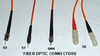
A wide variety of optical fiber connectors are available for numerous different applications. Their uses range from simple single-channel fiber-to- fiber connectors in a benign location to rugged multichannel connectors used underwater or for harsh military field environments. Connectors are available in designs that screw on, twist on,...