Optical Communications Essentials

One of the first steps that must be followed before fibers are connected or spliced is to prepare the fiber end faces properly. In order not to have light deflected or scattered at the joint, the fiber ends must be flat and smooth and must have the proper angle relative to the axis (either perpendicular or at an 8 angle). Common end preparation techniques include a grinding and polishing method and a controlled-fracture procedure.
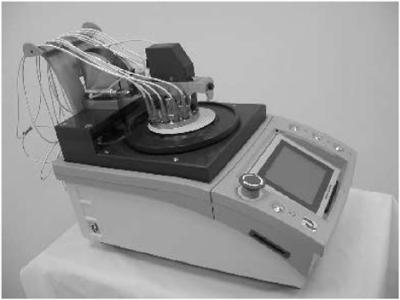
Conventional grinding and polishing techniques can produce a very smooth surface. Normally this is done in a controlled environment such as a laboratory or a factory, but polishing machines also are available for use in the field to attach connectors and to perform emergency repairs. The procedure employed is to use successively finer abrasives to polish the fiber end face. The end face is polished with each successive abrasive until the scratches created by the previous abrasive are replaced by the finer scratches of the present abrasive.
The number of abrasives used in this step-down approach depends on the degree of smoothness that is desired. Fiber inspection and cleanliness are important during each step of fiber polishing. This inspection is done visually by the use of a standard microscope at 200 to 400 times magnification. Figure 8.8 gives an example of a polishing machine that can prepare several fibers simultaneously.