Power Generation Handbook: Selection, Applications, Operation, and Maintenance
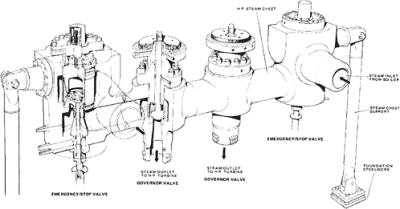
The steam leaving the superheater goes through the emergency stop valves (ESVs) and associated governing valves (GVs) before entering the high-pressure (HP) turbine.1 The ESVs and GVs are housed in steam chests. These steam chests are manufactured from closed-die alloy-steel forgings welded together, or from alloy-steel castings. They also have simple shapes. This is done to reduce the thermal stresses and hence the possibility of thermal fatigue.
Similar steam chests house the reheat emergency stop valves (RESVs) and interceptor valves (IVs). These steam chests are located between the reheater and the intermediatepressure (IP) turbines. They are manufactured from alloy-steel castings. They are thinner but larger than the HP steam chests due to lower steam pressures.
The steam chests are normally mounted alongside the turbine. The four steam mains, together with four ESVs and four GVs, are normally arranged two on each side of the turbine.
Figure. 5.1 illustrates a typical steam chest arrangement of a 660-MW unit. There is a steam chest on each side of the machine. It has an ESV on each end and the two GVs are connected to the common chamber between the ESVs.
The chests are manufactured from alloy steel. On 660-MW units operating at 565 C, the material is usually 0.5 CrMoV steel. In some recent units operating at 538 C, the chest material is 2.25 Cr steel. Higher-chrome ferrite steels with improved creep resistance are also used on larger units operating...