THE NONIDEAL BRAYTON CYCLE
The Brayton cycle with fluid friction is shown in Figure 21.1 by area 1-2-3-4.
 Figure 21.1: P-V and T-s diagrams of ideal and nonideal Brayton cycle.
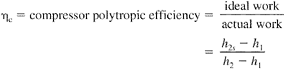
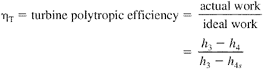
 If we assume constant specific heats
and
and for constant specific heats
The net power of the cycle is
For constant specific heats
| (21.1) | 
|
or
| (21.2) | 
|
This equation can be written in terms of the initial temperature T 1, a chosen metallurgical limit T 3, and the compressor and turbine efficiencies [Eqs. (21.1) and (21.2)] to give
| (21.3) | 
|
The second quantity in parentheses is the efficiency of the corresponding ideal cycle.
As in the case of the ideal cycle, the specific power of the nonideal cycle,  reaches a maximum value at some optimum pressure ratio. The heat added in the cycle is given by:
| (21.4) | 
|
The efficiency of the nonideal cycle can be obtained by dividing Eq. (21.3) by Eq. (21.4). Although the efficiency of the ideal cycle is independent of cycle temperatures, the efficiency of the nonideal cycle is very much a function of the cycle temperatures. The efficiency of the nonideal cycle reaches a maximum value at an optimum pressure ratio. The two optimum pressure ratios, for specific power and for efficiency, have different values. Therefore, a compromise in design is necessary.
Other irreversibilities (e.g., fluid friction in heat exchangers, piping, etc.) have not been included in Fig. 21.1. There is a pressure drop between points 2 and 3. Also, the pressure at point 4...


 TABLE OF CONTENTS