Power Generation Handbook: Selection, Applications, Operation, and Maintenance
The design, operation, and performance of electricity-generating power plants are based on thermodynamic principles.1 ,2
The first law of thermodynamics is the law of conservation of energy. It states that energy can be neither created nor destroyed. The energy of a system undergoing change (process) can vary by exchange with the surroundings. However, energy can be converted from one form to another within that system.
A system is a specified region, not necessarily of constant volume or fixed boundaries, where transfer and conversions of energy and mass are taking place. An open system is one where energy and mass cross the boundaries of the system. A steady-state open system, also called the steady-state, steady-flow (SSSF) system, is a system where mass and energy flows across its boundaries do not vary with time, and the mass within the system remains constant.
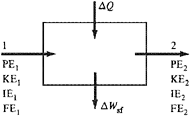
An SSSF system is shown in Fig. 1.1.
The first-law equation for that system is
| (1.1) | |
where PE = potential energy [= mzg/ g c , where m = mass of quantity of fluid entering and leaving the system, z = elevation of station 1 or 2 above a datum,
g = gravitational acceleration, and g c = gravitational conversion factor (32.2 lb m ft/(lb f