Practical Optical System Layout and Use of Stock Lenses

2.2: Stops and Pupils

2.2 Stops and Pupils

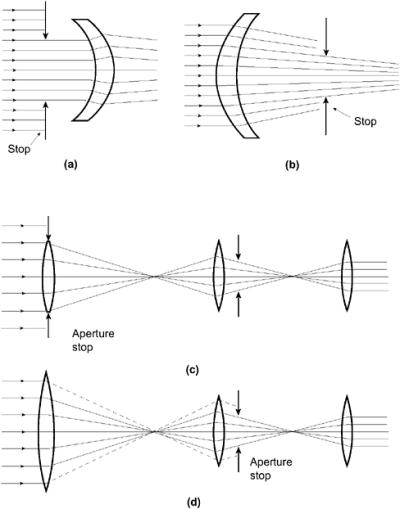
We begin with a discussion of an often neglected but vital aspect of optical systems, the concept of the aperture stop. In every optical system there is some feature, usually a diameter, which limits the size or diameter of the beam of rays which can pass through the system. If the system consists of just a single simple lens, the aperture stop is just the clear aperture of the lens. In a typical camera lens the iris diaphragm is the aperture stop. In a telescope the clear aperture of the objective lens (or that of the primary mirror) is ordinarily the aperture stop. Often the aperture stop is referred to simply as "the stop."

Figure 2.1 illustrates several examples of aperture stops. Note that Fig. 2.1C and D shows exactly the same system, except that the objective lens diameter is larger in Fig. 2.1D . This shifts the beam-limiting diameter from the objective lens to the internal diaphragm, which becomes the stop. The stop can be determined by tracing a fan or cone of rays from the axial object point and determining which feature most limits the size of the ray bundle.


Figure 2.1: The aperture stop: ( A) The aperture stop placed before a single element. ( B) The aperture stop placed behind the lens. ( C) An erecting telescope with the aperture stop located at the objective lens. ( D) The same optics as in

UNLIMITED FREE
ACCESS
TO THE WORLD'S BEST IDEAS

SUBMIT
Already a GlobalSpec user? Log in.

This is embarrasing...

An error occurred while processing the form. Please try again in a few minutes.

Customize Your GlobalSpec Experience

Category: Optical Apertures
Finish!
Privacy Policy

This is embarrasing...

An error occurred while processing the form. Please try again in a few minutes.