Practical Optical System Layout and Use of Stock Lenses

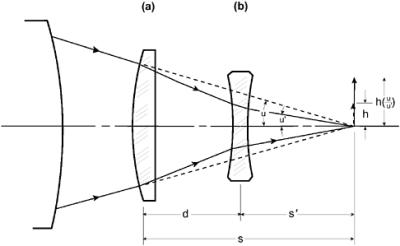
The Bravais system, shown in Fig. 2.9, can be regarded as the finite conjugate version of an afocal system. The object and image of the Bravais are in the same location, but the size of the image is changed by the linear magnification of the Bravais. In Fig. 2.9 the (virtual) object for the Bravais system is the image formed by the optical system to the left of the figure. The component powers for a Bravais can be found using Eqs. (1.33) and (1.34), setting T equal to zero, so that T = d+ s ? ? s = 0. Then the component powers are
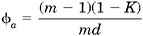
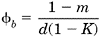
| (2.13) | |
| (2.14) | |
| (2.15) | |
Note that, for the system shown in Fig. 2.9, the magnification m (equal to u/u ?) is positive and greater than 1. A positive magnification of less than 1, with the component powers in reverse order from that shown in the figure, is quite possible, but this is a somewhat more difficult system.
Lay out a 2 Bravais system, 2 in long (i.e., 2 in from lens a to the image). Find the component powers.
With reference to Fig. 2.9, s must be 2 in,...