Practical Optical System Layout and Use of Stock Lenses

The magnification of a microscope or a magnifier is, like that of a telescope, defined as the ratio of the angle subtended by the image to the angle subtended by the object. The difficulty here is that we are concerned with an object at a finite distance, and the angle which the object subtends will vary with that distance. The answer to this dilemma is that the object is considered to be viewed at a conventional distance of 10 in, chosen as the "nearest distance of distinct vision." This convention is obviously a compromise, since the eyes of a young person can focus to a distance of a few inches, whereas an older individual may be unable to focus closer than several feet.
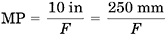
If the object to be examined is placed at the focal point of the microscope/magnifier, the image is seen at infinity, and the magnification is simply
| (2.16) | |
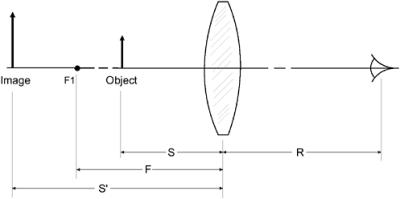
This expression is valid for either a simple magnifying glass or a compound microscope, where F is the effective focal length of the microscope/magnifier. If, as shown in Fig. 2.12, the object is between the lens and the first focal point, then the magnification depends not only on the focal length F, but also on the image distance S ?, as well as the distance from the magnifier to the eye R, as follows: