Practical Optical System Layout and Use of Stock Lenses

2.4: Telescopes and Beam Expanders

2.4 Telescopes and Beam Expanders

Kepler or astronomical telescope. As shown in Fig. 2.5, in the keplerian telescope both the objective and eyepiece have positive focal lengths. Thus, per Eq. (2.4), the magnification is negative, indicating that the image is inverted; it is upside down and reversed left to right. For terrestrial use, as in binoculars, for example, where an inverted image is quite undesirable, the image is often erected by either an erector lens or a prism system, as discussed in Sec. 1.12. If the lenses are "thin," the length of the system is given by

(2.5)

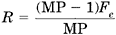
The exit pupil is real and accessible, and the eye relief (again, for thin lenses) is

(2.6)

Sample calculations

Lay out a 10-in-long, 4 Kepler telescope. Find the eye relief. Equation (2.4) defines the magnification, Eq. (2.5) the length, and Eq. (2.6) the eye relief. We can solve Eqs. (2.4) and (2.5) simultaneously to get the component powers as follows:

(2.7)
(2.8)

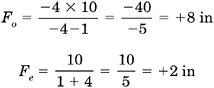
Note that since the Kepler is an inverting telescope we must use MP = ( ?4 ) as the power, and we get


Equation (2.6) gives the eye relief as


Galilean or Dutch telescope. The galilean telescope (Fig. 2.6) has a positive objective and a simple (i.e., not compound) negative eyepiece. The angular magnification is positive and the image is erect. The field of view of this telescope tends to be small and is limited by the speed ( f-number) of the objective. As...

UNLIMITED FREE
ACCESS
TO THE WORLD'S BEST IDEAS

SUBMIT
Already a GlobalSpec user? Log in.

This is embarrasing...

An error occurred while processing the form. Please try again in a few minutes.

Customize Your GlobalSpec Experience

Category: Beam Expanders
Finish!
Privacy Policy

This is embarrasing...

An error occurred while processing the form. Please try again in a few minutes.