Practical Optical System Layout and Use of Stock Lenses

2.9: Telephoto and Retrofocus Arrangements

2.9 Telephoto and Retrofocus Arrangements

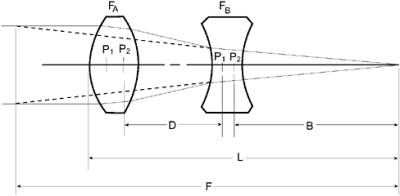
A schematic telephoto arrangement is shown in Fig. 2.14. It consists of a positive component separated from a negative component. The focal length, back focus, etc., relationships are defined by the equations of Sec. 1.10. As can be seen from the figure, the advantage of the telephoto arrangement is that its focal length is longer than its overall length. One can get a long focal length lens in a short, compact package. The telephoto ratio is the length L divided by the effective focal length F, and a lens is classed as a true telephoto if this ratio is less than 1. In reflecting systems, the Cassegrain configuration, as shown in Fig. 1.16, is the mirror equivalent of a telephoto.


Figure 2.14: A telephoto lens consists of a positive component followed by a negative component. The combination has a focal length F which is longer than its overall length L and is used where a long focal length in a compact package is desired. The telephoto ratio is L/F; a ratio of less than 1 is considered the defining characteristic of a telephoto.

A schematic retrofocus or reversed telephoto system is shown in Fig. 2.15. It consists of a negative component followed by a positive component. The advantage of this arrangement is that the back focus distance is long compared to the focal length. This is useful if a long working distance is needed in...

UNLIMITED FREE
ACCESS
TO THE WORLD'S BEST IDEAS

SUBMIT
Already a GlobalSpec user? Log in.

This is embarrasing...

An error occurred while processing the form. Please try again in a few minutes.

Customize Your GlobalSpec Experience

Category: Spherical Lenses
Finish!
Privacy Policy

This is embarrasing...

An error occurred while processing the form. Please try again in a few minutes.