2.3 Afocal Systems: General
An afocal system is one which images an infinitely distant object at infinity. It is called afocal because it has no focal length (or an infinite one; either concept can be a nuisance). Telescopes, beam expanders, power and field changers, as well as telephoto and wide-angle attachments, are examples of afocal systems.
An afocal system can form an (infinitely distant) image which subtends an angle which is larger or smaller than the angle subtended by the object. The ratio of the angle subtended by the image to that subtended by the object is the angular magnification, or magnifying power, MP, of the afocal system. If the image is enlarged, as in a telescope, MP > 1.0; if the image is smaller than the object, MP < 1.0. When the image appears erect, MP is positive; a negative MP indicates an inverted image.
The magnification MP, the diameters of the entrance pupil P and exit pupil P ?, and the angular size of the real (object side) field A and the apparent (image side) field A ? are all related by the following equation:
| (2.1) | 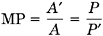
|
Equation (2.2) gives this relationship for finite (as opposed to infinitesimal/paraxial) field angles:
| (2.2) | 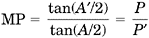
|
All afocal systems must obey these relationships. For example, in a typical 6 binocular, the exit pupil diameter must be one-sixth of the entrance pupil diameter, and the apparent (image) field must be six times the real (object)...


 TABLE OF CONTENTS