Radar System Analysis and Modeling

Chapter 4: Radar Antennas

4.1 RADAR RESPONSE IN FOUR COORDINATES

4.1.1 Radar Resolution

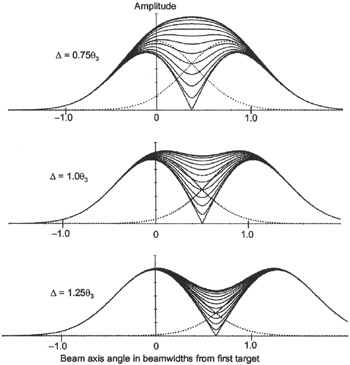
Radar observes targets in four-dimensional space: two angles (often specified as azimuth and elevation), time delay (proportional to range), and frequency (doppler shift, proportional to target radial velocity). A target is said to be resolved if its signal is separated from those of other targets at the radar output in at least one of these coordinates. A surveillance radar, for example, may scan its beam in azimuth and elevation, and detect a target in a particular range gate and doppler filter. A second target signal is resolved if it lies in a different azimuth or elevation beam position, or in a different range gate or doppler filter. A useful criterion for resolution is that the position of the desired target should be measurable by the radar with only small errors caused by the other target. As shown in Figure 4.1, the relative phase and amplitude of the second target affect the resolution process. However, for two targets of equal amplitude and arbitrary phase, resolution is normally possible when they are separated by approximately the half-power beamwidth or the half-power width of the processed pulse or doppler filter.


Figure 4.1: Resolution of signals from target returns spaced by ? = 0.75 to 1.25 beamwidths, with phase varying in steps of 15 .

Resolution is thus determined by the relative response of the radar to targets separated from the one to which the radar is directed, or matched. The antenna and...

UNLIMITED FREE
ACCESS
TO THE WORLD'S BEST IDEAS

SUBMIT
Already a GlobalSpec user? Log in.

This is embarrasing...

An error occurred while processing the form. Please try again in a few minutes.

Customize Your GlobalSpec Experience

Category: LiDAR Sensors
Finish!
Privacy Policy

This is embarrasing...

An error occurred while processing the form. Please try again in a few minutes.